Off the Rack, On Your Terms: The Quiet Flex of a $15 Hem
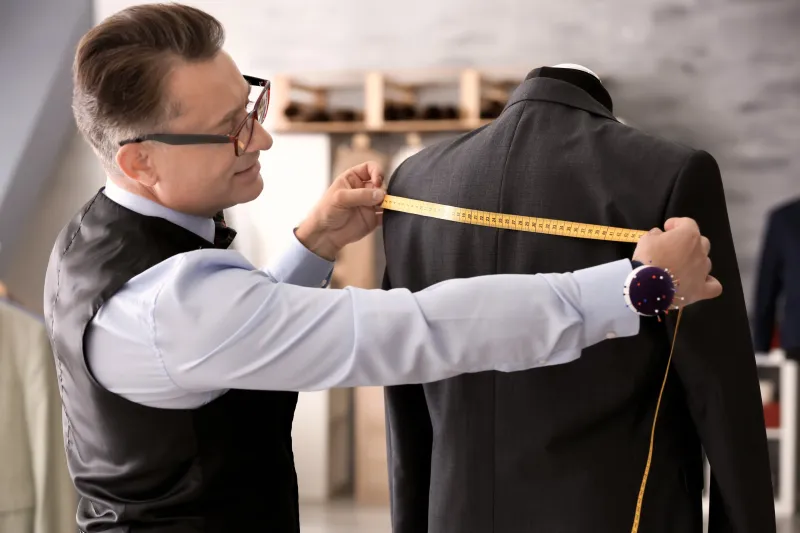
Photo: tailor measuring suit jacket menswear alteration shop, via www.mysuittailor.com
There's a moment every guy knows. You're standing in front of the fitting room mirror, jeans that almost work, a blazer that almost sits right, and you make the call: good enough. You buy it, you wear it, and every time you catch your reflection, something's a little off. The sleeve swallows half your hand. The hem breaks weird over your sneakers.
Here's what changed: guys stopped accepting almost. Tailoring — the thing your grandfather did without thinking — is having a full-blown moment, and it might be the most underrated style move of the decade.
Why 'It's Tailored' Beats 'It's Designer'
Anyone can swipe a card for a logo. It takes zero taste to spend $900 on a jacket with the right name stitched inside the collar. But walking around in a $60 thrifted sport coat that fits like it was made for you? That signals something different. It says you know.
That's the shift happening right now. A whole wave of guys in their twenties and thirties got priced out of the resale hype cycle, looked at their closets, and realized the problem was never the clothes — it was the fit. A $15 hem on a pair of vintage Levi's does more for your look than any hyped sneaker drop ever will. Fit is the difference between wearing clothes and being worn by them.
There's also a practical angle driving this. Off-the-rack sizing in America is built for nobody. It's an average of averages. Unless you happen to be a 38 regular with 32-inch inseams and standard everything, most of what you buy is a compromise. A tailor erases the compromise.
The Thrift-to-Tailor Pipeline
Walk into any good secondhand shop — Buffalo Exchange, your local Salvation Army, that one estate sale spot in your town — and the racks are full of quality wool, real horn buttons, and selvedge denim at a fraction of retail. The catch? It almost never fits.
That used to be the dealbreaker. Now it's the whole point. Guys are buying a $40 wool overcoat with baggy 90s shoulders and paying $60 to have it reshaped into something that looks like it came from a boutique. Total damage: $100 for a coat that would run four figures new. The math isn't subtle.
Same story with denim. Raw or vintage jeans hemmed to hit exactly right at your shoe — no stacking, no puddle, no awkward break — instantly makes a $30 thrift find look intentional.
What Can Actually Be Altered (and What Can't)
Before you show up with a garbage bag of clothes, know the rules of the game.
Almost always worth it:
- Pant hems and tapering. The cheapest, highest-impact alteration there is. If your pants don't fit right, nothing else matters.
- Sleeve length on jackets. A tailor can shorten sleeves from the cuff side on most jackets. You want about a half inch of shirt cuff showing.
- Shirt bodies. A boxy dress shirt taken in at the sides transforms your whole silhouette.
- Waistbands. Taking pants in or letting them out an inch or two is routine work.
- Blazer side seams. Trimming a too-roomy body is standard and reasonably priced.
Sometimes possible, sometimes not:
- Shoulders on suits and blazers. This is the big one. Shoulder work is expensive and risky. If the shoulders are wildly wrong, walk away — no alteration fixes them cheaply.
- Letting things out. There has to be extra fabric in the seams to work with. Sometimes there isn't.
Don't bother:
- Cheap knitwear, anything with pattern-matching that would get destroyed, and garments where the alteration costs more than replacement.
What It Should Cost
Ballpark numbers so nobody gets fleeced:
- Jean hem (with original cuff preserved): $15–$25
- Simple hem, no cuff: $10–$15
- Shirt taken in at the sides: $15–$25
- Sleeve shortening on a jacket: $25–$50
- Blazer body adjustment: $40–$75
- Full suit adjustment (multiple points): $75–$150
Prices run higher in New York, LA, and Chicago, lower in smaller markets. If someone quotes you $90 to hem jeans, leave.
Finding Your Guy
The best tailors are rarely the ones with websites. Ask the best-dressed older guy you know. Ask a local menswear shop — they all have a person they send clients to. Read Google reviews for the words "fast," "fair," and "fixed my suit before my wedding."
Go in with one easy job first — a hem, something low-stakes. See how they communicate, how they handle timelines, whether they ask you questions about how you want it to break. A good tailor is a relationship, not a transaction. Once you have one, you'll never look at a rack of clothes the same way again. Every too-big blazer becomes an opportunity. Every thrift score becomes a project.
The Real Point
Getting something altered is a small act of giving a damn. It's slower than next-day shipping and quieter than a logo, and that's exactly why it lands. The guy in the perfectly hemmed denim and the fitted thrift store blazer isn't chasing a trend. He's defining his era — one stitch at a time.